

Exnovation Avoidance
How We Trick Ourselves Into Thinking We’ve Changed

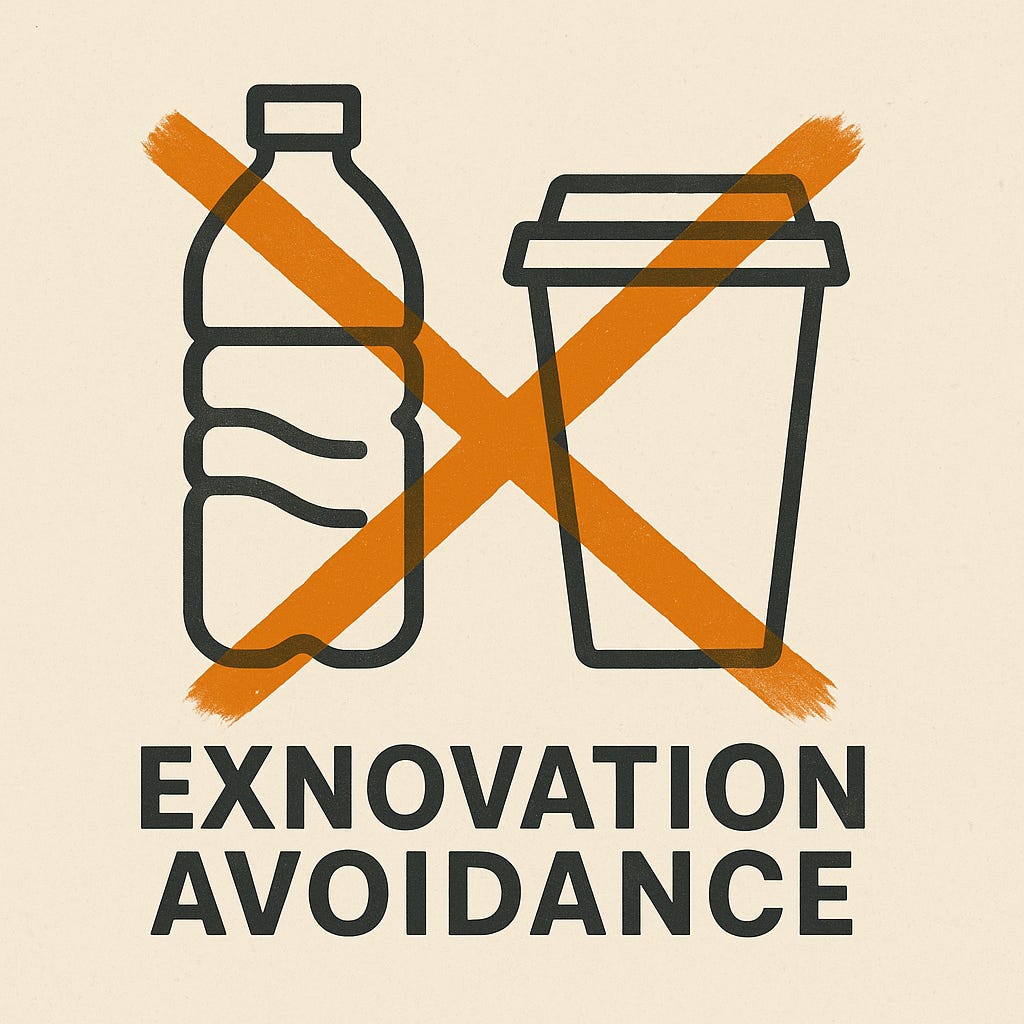
Not all transitions are real.
Some just look like progress.
This is the quiet art of staying the same—by pretending to change.
You’ve probably seen it: the compostable cup that looks green but ends up in landfill. The AI recycling bin trial that disappears after a month. The supermarket pledging to reduce plastic while rolling out new packaging “solutions” that still rely on fossil-derived materials.
These aren’t examples of progress.
They’re examples of exnovation avoidance.
In the first article, I introduced exnovation as the structured process of letting go—of phasing out systems, behaviours, or materials that no longer serve us. But what happens when we fail to do that, and instead wrap the status quo in shiny new layers?
That’s what this post explores.
The Performance of Change
We live in an age obsessed with appearances. In sustainability circles, that means every initiative must look ambitious, green, and tech-savvy. But many so-called “solutions” are not dismantling unsustainable systems—they’re redecorating them.
This is exnovation avoidance:
It appears to be transition.
It feels like action.
But it leaves the underlying structure intact.
It’s not just greenwashing. It’s organised persistence—the deliberate reinforcement of existing behaviours, technologies, or infrastructures under the guise of change.
Let’s make this concrete.
Case in Point: The Smart Recycling Bin
During the COP26 climate summit, a trial scheme in Cardiff introduced AI-enabled recycling bins. Coffee chains partnered with a tech start-up to “transform recycling rates.” Customers scanned QR codes on their takeaway cups. Data was collected. Bins beeped cheerily.
It was slick, eye-catching—and short-lived.
The trial quietly ended. The cups remained the same. No systemic phase-out of single-use culture occurred. Behaviour didn’t shift. The initiative looked good in a press release, but functioned primarily as a strategic pause button on real change.
It was innovation masking the absence of exnovation.
Why We Fall for It
Exnovation avoidance thrives in the spaces between:
Convenience and discomfort: We don’t want to give up familiar habits.
Corporate narrative and actual accountability: Businesses tell sustainability stories that are easy to tell, but hard to verify.
Innovation hype and governance inertia: Policymakers favour tech-led pilot schemes over structural reform.
This creates fertile ground for half-measures that sound transformative but maintain behavioural and material entrenchments.
And let’s be honest—sometimes we want to believe it’s enough. It’s less scary than letting go.
How to Spot Exnovation Avoidance
In my work, I’ve started developing a diagnostic tool—the REACT Framework—to track where exnovation is genuine, and where it’s being side-stepped. But even without a framework, you can ask:
Does this intervention actually remove or retire anything?
Are core behaviours or materials being challenged—or just rebranded?
Is this a pilot, or a pathway to policy?
Who benefits if nothing really changes?
The answers are often revealing. For example, in the AI case illustration above, this project scores a low 23/100. This places the initiative in the lowest tier of genuine exnovation efforts. It appears innovative, but fails to structurally or behaviourally detach from the core unsustainable practice, signalling organised persistence disguised as progress.
Why It Matters
Performative sustainability isn’t just annoying.
It’s dangerous.
It crowds out real action. It saps urgency. It trains us to applaud illusions.
And in doing so, it delays the systemic letting go we so urgently need.
That’s why The Exnovation Files doesn’t just celebrate radical change. It critiques false exits. It examines the quiet comfort of continuity. And it asks harder questions about the stories we’re told—and the ones we tell ourselves.
“Micro consumerist bollocks.”
—George Monbiot, on tokenistic environmental action.
Up Next
The next article will begin to unpack the REACT Framework—a tool to help organisations, policymakers, and citizens map out real exnovation.
Not just what’s been done—but what’s still being held on to.
Make sure you’re subscribed to get it as soon as it drops.
Innovation dazzles.
But exnovation demands honesty.
Stay with me as we keep unpicking the layers.